
Gas bills confuse people for a few consistent reasons: they use unfamiliar units like therms, the charges stack up quickly in winter, and the month-to-month swings feel unpredictable even when household habits feel the same.
Most of the variation comes down to two things: how many therms you used, and what the commodity cost per therm was that month. This page explains every major line item on a typical U.S. residential natural gas bill.
What You Can Control — At a Glance
- High control: How many therms you use. Heating load is the main driver for most households.
- Medium control: Appliance settings and behavioral habits — thermostat schedules, water heater temperature, insulation.
- Low control: Gas commodity prices, delivery rates, customer charges, taxes, and riders. These are market-driven or regulated.
Account & Service Information
Your name, service address, account number, and gas utility company. Used only to identify your account — it does not affect how much you pay.
Control level: None. Find it on your bill: Account or customer information section.
Billing Period & Meter Readings
What it is
The dates your bill covers and your gas meter readings. Readings may be marked actual (a physical or electronic read) or estimated (projected from usage history when a read isn’t taken).
Why it matters
If a bill uses an estimated reading, the next bill may correct upward or downward when an actual read occurs. A bill that looks unusually high is often a correction month following an underestimated prior read.
Control level: Low. Find it on your bill: Meter readings or usage summary section.
Gas Usage (Therms)
What it is
Gas usage is billed in therms, which measure heat energy. One therm equals 100,000 BTUs. Therms are the main driver of gas bills — especially for homes that rely on gas for heating.
Find it on your bill
Look for: Usage, Therms Used, Consumption.
Control level: High.
Heat Content / BTU Factor
Natural gas energy content varies slightly by region and season. Utilities apply a heat content factor to convert gas volume (CCF or Mcf) into therms, ensuring customers are billed for actual energy delivered rather than raw volume.
Control level: None. Find it on your bill: Heat factor, BTU factor, or therm conversion line.
Supply Charges (Gas Commodity Cost)
What it is
Supply charges cover the cost of the natural gas commodity itself, billed per therm. They reflect wholesale gas prices, which change with market supply and demand. Rates vary by location and season — check your utility’s current tariff for the rate that applies to your account.
Find it on your bill
Look for: Gas Supply, Commodity Charge, Gas Cost.
Control level: Medium. You can’t control the price per therm, but reducing therm usage directly reduces what this charge costs you.
Delivery Charges (Distribution & Infrastructure)
What it is
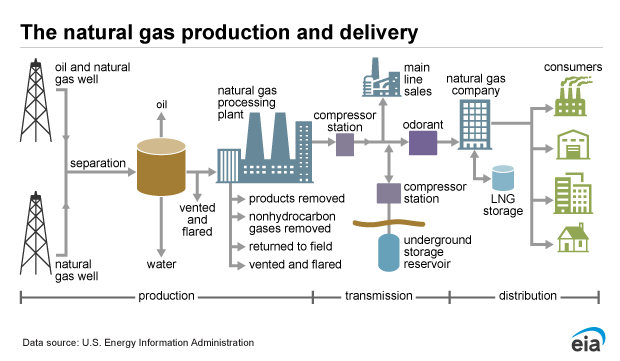
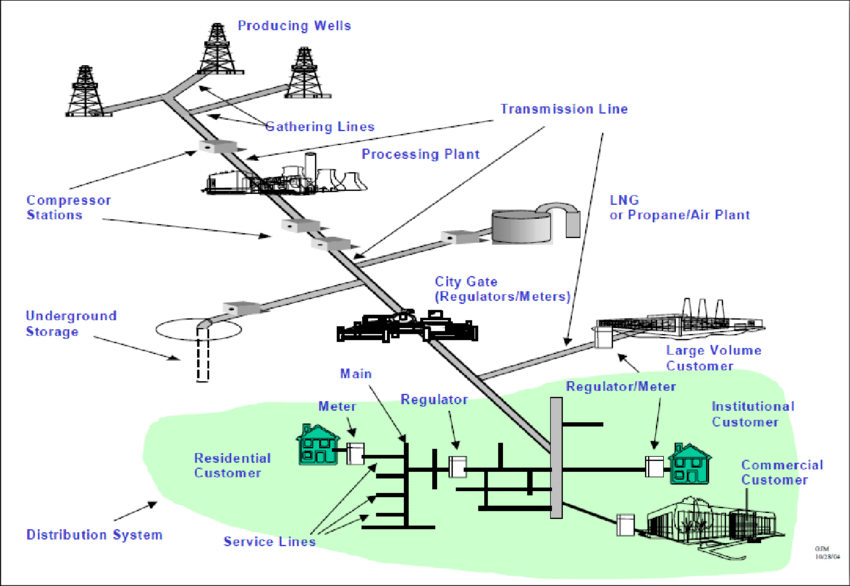
Delivery charges pay for pipelines, meters, maintenance, and emergency services. They exist regardless of how low commodity prices fall, because infrastructure costs are fixed.
Find it on your bill
Look for: Distribution Charge, Delivery Charge, Transportation Charge.
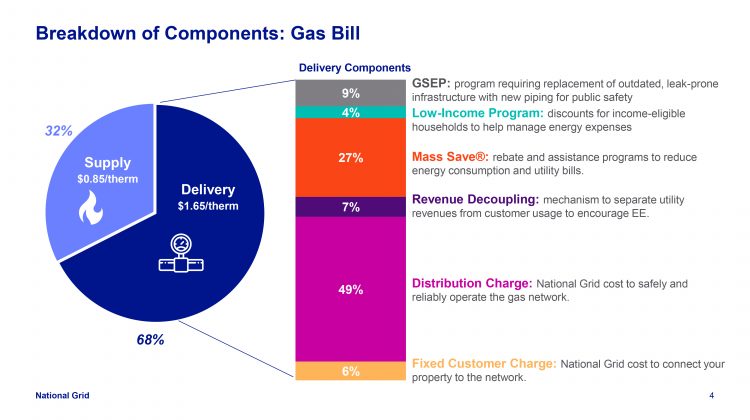
Control level: Low. The rate is set by regulators. Reducing therm usage lowers the variable portion but not the fixed customer charge component.
Fixed Monthly Customer Charge
A flat monthly fee for being connected to the gas system. It applies even if little or no gas is used during the billing period, covering the fixed costs of your service connection — metering, account management, and the physical tap into the distribution system.
Control level: None. Find it on your bill: Customer Charge, Basic Service Fee.
Fees, Riders, and Adjustments
These line items recover specific approved costs such as infrastructure upgrades, safety programs, and regulatory adjustments. Each is usually small individually, but together they add to the bill. Names vary widely by utility.
Control level: None. Find it on your bill: Riders, Surcharges, Adjustments.
Taxes and Government Charges
State and local taxes added to most gas bills. Rates vary by state and municipality — check your utility’s tariff or your state public utility commission’s website for the applicable rates.
Control level: None. Find it on your bill: Taxes, Governmental Charges.
What You Can Do — High-Impact Areas
Home Heating
Heating accounts for the majority of gas consumption in most homes during winter. Thermostat setback — lowering the temperature when away or asleep — is the most consistently supported way to reduce heating therms without major changes.
Water Heating
Water heating is commonly the second-largest gas use in homes with gas water heaters. Lowering the water heater to 120°F, fixing hot-water leaks, and insulating hot-water pipes are frequently cited ways to reduce this load.
Air Sealing & Insulation
Unsealed homes require more heating therms to maintain a given indoor temperature. Common problem areas: attic bypasses, basement rim joists, around doors and windows, and fireplace dampers left open. Sealing these reduces heating load without changing thermostat settings.
Example Gas Bill Math
Example 1: Normal winter bill
- Usage: 100 therms
- Supply: $0.80/therm → $80.00
- Delivery: $0.50/therm → $50.00
- Customer charge: $15.00
- Taxes and fees: $10.00
- Total: $155.00
These are illustrative numbers only. Supply and delivery rates vary by utility and location.
Example 2: What a rate increase looks like
Same usage — 100 therms. Supply rate rises from $0.80 to $1.10/therm. The difference: 100 × $0.30 = $30 more, with no change in behavior. This is how a commodity price shift shows up even when you haven’t changed how much gas you use.
Example 3: Estimated reading correction
If the prior month used an estimated read that was too low, the following month’s actual read captures the uncounted usage. The bill looks unusually high, but it reflects gas that was used — just not billed in the right period.
Natural Gas Cost Calculator
🔥 Natural Gas Cost Calculator
Enter values from your bill. Supply + Delivery rates in dollars per therm (e.g. 0.80 = 80¢/therm). Fixed charges in dollars per month.
Frequently Asked Questions
Why is my gas bill so high in winter?
Heating accounts for the majority of gas consumption in most homes. Cold weather means the heating system runs longer to maintain indoor temperature. Bills can also increase when commodity prices rise, which often happens in winter due to higher regional demand.
What is a therm, and how is it different from CCF?
A therm is a unit of heat energy equal to 100,000 BTUs. A CCF is 100 cubic feet of gas volume. Utilities convert CCF to therms using a heat content factor, because the actual energy in a given volume of gas varies slightly. Your bill is typically based on therms, not raw volume.
What’s the difference between supply and delivery on a gas bill?
Supply is the cost of the gas commodity — what the utility paid for the gas. Delivery covers the pipelines, compressor stations, meters, and maintenance that move gas to your home. Both are charged per therm, but supply is more volatile because it tracks wholesale market prices.
Why did my bill go up even though I used the same amount?
Supply rates change — sometimes monthly. A higher commodity price means a higher bill at identical usage. Also check whether billing days changed or whether a prior estimated read is being corrected.
Sources
- U.S. Energy Information Administration — Natural Gas Explained
- U.S. Department of Energy — Thermostats (Energy Saver)
- DOE Energy Saver — Water Heating
- DOE Energy Saver — Air Sealing Your Home
Last reviewed: March 2026. Explanations are general and may vary by utility provider.