
Most people get a bill, pay it, and move on. That works until the month something jumps $40 with no obvious reason. Then the bill becomes 10 lines of jargon and a total that doesn’t quite add up.
The frustrating part is that the charges aren’t hidden — they’re just labeled in ways that assume you already know what they mean. Transmission charge. Fuel cost adjustment. Distribution rider. Each one has a clear explanation. None of them live on your bill.
This page breaks down every major charge on a typical U.S. residential electric bill — what it is, why it exists, what drives it, and what you can actually do about it.
What You Can Control — At a Glance
- High control: How much electricity you use (kWh). This is the single biggest driver on most residential bills.
- Medium control: When you use it — if your utility uses peak/off-peak or time-of-use rates, shifting load matters.
- Low control: Rates, distribution fees, riders, taxes, and the customer charge. These are set by your utility or state regulators.
>> Jump to: Electric Cost Calculator
How Electricity Gets to Your Meter
Your bill splits into two main categories: Supply (the electricity itself) and Delivery (the infrastructure that moves it to your home). Understanding that split explains why switching suppliers — in states where that’s possible — only affects roughly half your bill.
Simplified path: Generation → Transmission (high-voltage lines) → Substation → Distribution (local lines) → Meter → Your Bill
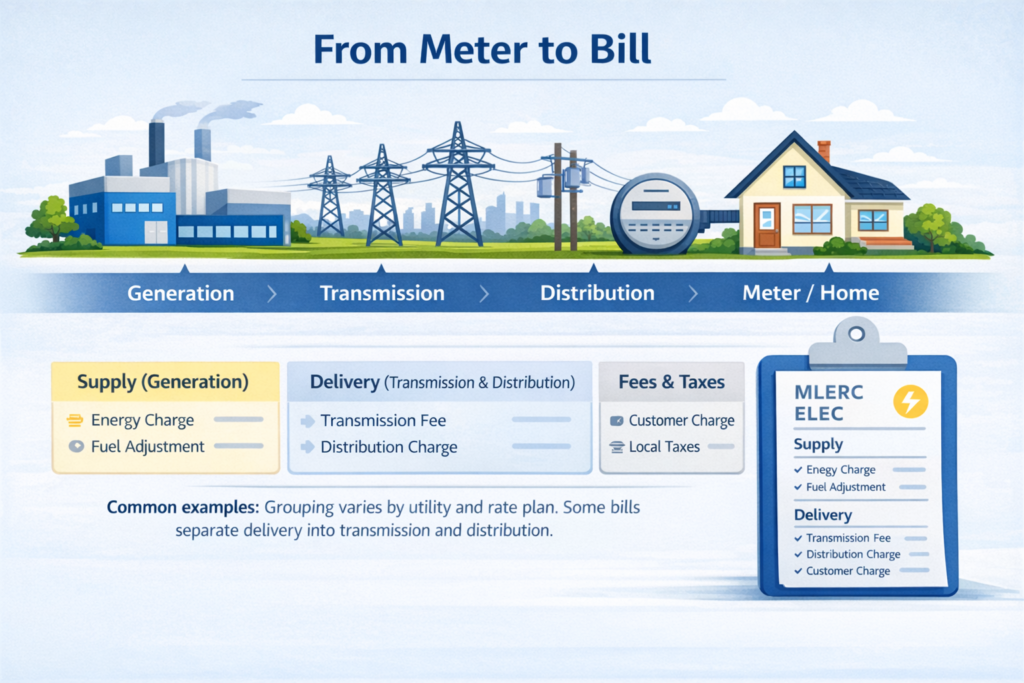
Supply vs. Delivery
What it is
Supply is the cost of the electricity commodity — the power itself. Delivery is the cost of moving it through transmission lines, substations, and local distribution lines to your meter. Both appear on almost every residential bill.
Find it on your bill
Look for: Supply Charges, Generation Charges, Delivery Charges, Distribution Charges.
Why it exists
Electricity is generated at power plants, then transported across a high-voltage transmission grid before stepping down through substations and traveling local distribution lines to your home. These are distinct services with different infrastructure costs, so utilities bill them separately.
Control level
High over the amount billed (usage). None over the per-kWh rates, which are regulated.
What drives it most
Supply: fuel prices (primarily natural gas), wholesale electricity market conditions, and your total kWh usage. Delivery: your utility’s infrastructure investment — these rates change slowly and require regulatory approval.
Energy / Usage Charge (kWh)
What it is
The charge for the electricity you consumed during the billing period, measured in kilowatt-hours (kWh). This is typically the largest single line item on a residential bill. One kWh is roughly what a 1,000-watt appliance uses in one hour.
Find it on your bill
Look for: Energy Charge, Usage (kWh), Consumption Charge.
Why it exists
You’re billed for each kilowatt-hour drawn from the grid. The more you use, the higher this charge — it scales directly with consumption.
Control level
High. Usage is the one major charge you can directly influence through habits and efficiency.
What drives it most
Heating and cooling, water heating, and large appliances. Seasonal shifts can move usage substantially even when habits feel the same — a slightly warmer month means more air conditioning; a colder one means more heat.
Practical settings and habits
Setting the thermostat a few degrees closer to outdoor temperature when away or asleep commonly reduces HVAC load. On time-of-use rate plans, shifting large appliances off-peak can reduce effective cost. LED lighting and ENERGY STAR appliances reduce baseline consumption over time.
Customer Charge (Basic Service Fee)
What it is
A flat monthly fee charged simply for being connected to the grid. It covers metering, billing administration, and the fixed costs of maintaining your service connection — and it applies every billing period regardless of how much you use.
Find it on your bill
Look for: Customer Charge, Basic Charge, Service Fee.
Why it exists
Utilities incur fixed costs regardless of consumption — meter reading, account management, and the physical service connection. This charge recovers those costs directly.
Control level
None. Reducing usage does not reduce this charge.
Transmission Charge
What it is
The cost of moving electricity over high-voltage transmission lines from generation facilities to local substations — the long-distance leg before distribution takes over. Not all utilities show this separately; some bundle it into the delivery charge.
Find it on your bill
Look for: Transmission Charge, Transmission Services.
Why it exists
High-voltage transmission infrastructure is built and operated by regional transmission organizations and utilities. Those costs are recovered from customers, with rates typically set by FERC and/or state regulators.
Control level
Low. The rate is regulated. Reducing total kWh lowers the variable portion, but the rate itself is outside your control.
Fuel Adjustment / PPAC / ECRC
What it is
A per-kWh adjustment that passes changes in the utility’s actual fuel costs — primarily natural gas used to generate electricity — directly to customers. It can be positive or negative and often changes monthly or quarterly.
Find it on your bill
Look for: Fuel Adjustment Clause, PPAC (Purchased Power Adjustment Clause), Energy Cost Recovery Clause (ECRC), Fuel Cost Adjustment.
Why it exists
When utilities file base rates with regulators, they estimate future fuel costs. The fuel adjustment clause lets them recover the difference between estimated and actual fuel costs — or pass savings back — without a full rate case every time fuel prices shift.
Control level
None over the rate. High over the kWh it’s applied to — reducing overall usage reduces what it costs you.
What drives it most
Natural gas prices. When gas spikes, this line item can add meaningfully to a bill even at flat usage. The current rate is set by your utility’s tariff and updated on a schedule approved by state regulators.
Renewable Energy & Efficiency Charges
What it is
Small per-kWh or flat charges that fund state-mandated renewable energy programs or energy efficiency initiatives. Despite the name, they do not mean the electricity delivered to your home is renewable.
Find it on your bill
Look for: Renewable Energy Charge, Energy Efficiency Rider, Clean Energy Fund, Conservation Charge.
Why it exists
State legislation often requires utilities to meet renewable portfolio standards or fund efficiency programs. Regulators allow utilities to recover those program costs through small charges spread across all customers.
Control level
None. These are regulatory pass-through charges — typically small on a residential bill.
Taxes & Government Fees
What it is
State and local taxes, municipal franchise fees, and public utility commission assessments. These are not utility revenue — they are government-imposed and the utility collects them on behalf of those entities.
Find it on your bill
Look for: State Tax, Franchise Fee, Municipal Tax, PUC Assessment.
Why it exists
Utilities operate under franchise agreements with local governments and are subject to state and local tax requirements. The charges fund general government services and the cost of utility regulation.
Control level
None. Rates are set by statute or ordinance.
Electric Cost Calculator
Enter your bill values to estimate monthly cost. Enter rates in dollars — for example, 0.12 means 12¢/kWh.
⚡ Electric Cost Calculator
Enter values from your bill. Supply + Delivery rates in dollars per kWh (e.g. 0.065 = 6.5¢). Fixed charges in dollars per month.
Note: This estimate assumes simple per-kWh pricing plus fixed fees. Time-of-use tiers, minimum bills, and demand charges can change the total. See your utility’s tariff for full details.
Frequently Asked Questions
Why did my bill go up if my usage looks the same?
Bills can increase even with flat usage. The most common reasons: a different number of billing days, a rate adjustment, an estimated read being corrected in a subsequent month, or seasonal baseline shifts that are easy to overlook. Check billing days and the supply rate on both statements before assuming anything changed about your habits.
What’s the difference between supply and delivery charges?
Supply is the electricity commodity — the cost of generating the power. Delivery is the cost of moving it through transmission lines, substations, and local distribution lines to your meter. In deregulated states you can sometimes choose a supply provider, but delivery always goes through your local utility at a regulated rate.
What is a fuel adjustment charge, and why does it change?
A fuel adjustment passes changes in the utility’s actual fuel costs — primarily natural gas used to generate electricity — to customers. Because fuel prices move with markets, this charge is often updated monthly or quarterly. When natural gas is expensive the adjustment is higher; when prices fall it can reduce or credit your bill.
Does a “renewable energy charge” mean I’m using green power?
No. This charge funds state-level renewable programs or portfolio compliance — it does not mean the electrons reaching your home are from renewable sources. If you want to specifically source renewable electricity, look into your utility’s green tariff or a renewable energy certificate program.
Can I lower my customer charge by using less electricity?
No. The customer charge is a flat monthly fee tied to having active service, not to consumption. The only way to eliminate it is to disconnect service entirely.
What should I compare first when two months look different?
Start with billing days and total kWh. Then check whether the meter read is marked actual or estimated. After that, compare the supply rate on both bills. If those match, look at riders, fuel adjustments, and taxes.
Sources
- U.S. Energy Information Administration — Electricity Explained
- EIA — How Electricity is Delivered to Consumers
- U.S. Department of Energy — Thermostats (Energy Saver)
- DOE Office of Electricity — Electricity 101
- ENERGY STAR — Save Energy at Home
Last reviewed: March 2026. Explanations are general and may vary by utility provider.
What is a kWh? | Why electricity rates change | Why summer electric bills spike