
How Wastewater Is Treated
Water goes down the drain and vanishes. The bill does not.
That gap is why sewer charges feel vague. Wastewater service is real work, but most of it happens underground and behind a fence at a treatment plant. This page walks through what usually happens after water leaves your home.
Problem
Sewer service is easy to underestimate because it is invisible on a normal day.
Most homes do not have a wastewater meter. Many utilities estimate sewer volume from indoor water use, because measuring wastewater at every property would add cost and complexity. So you see a sewer charge, but you do not see the system doing the job.
You are paying for a system you rarely notice until it fails.
Explanation
Wastewater treatment is a sequence. Names vary by location, but the flow shown matches the standard framework described by the U.S. Environmental Protection Agency and the U.S. Geological Survey.
Even when usage drops, the system still has to run.
What happens after water goes down the drain?
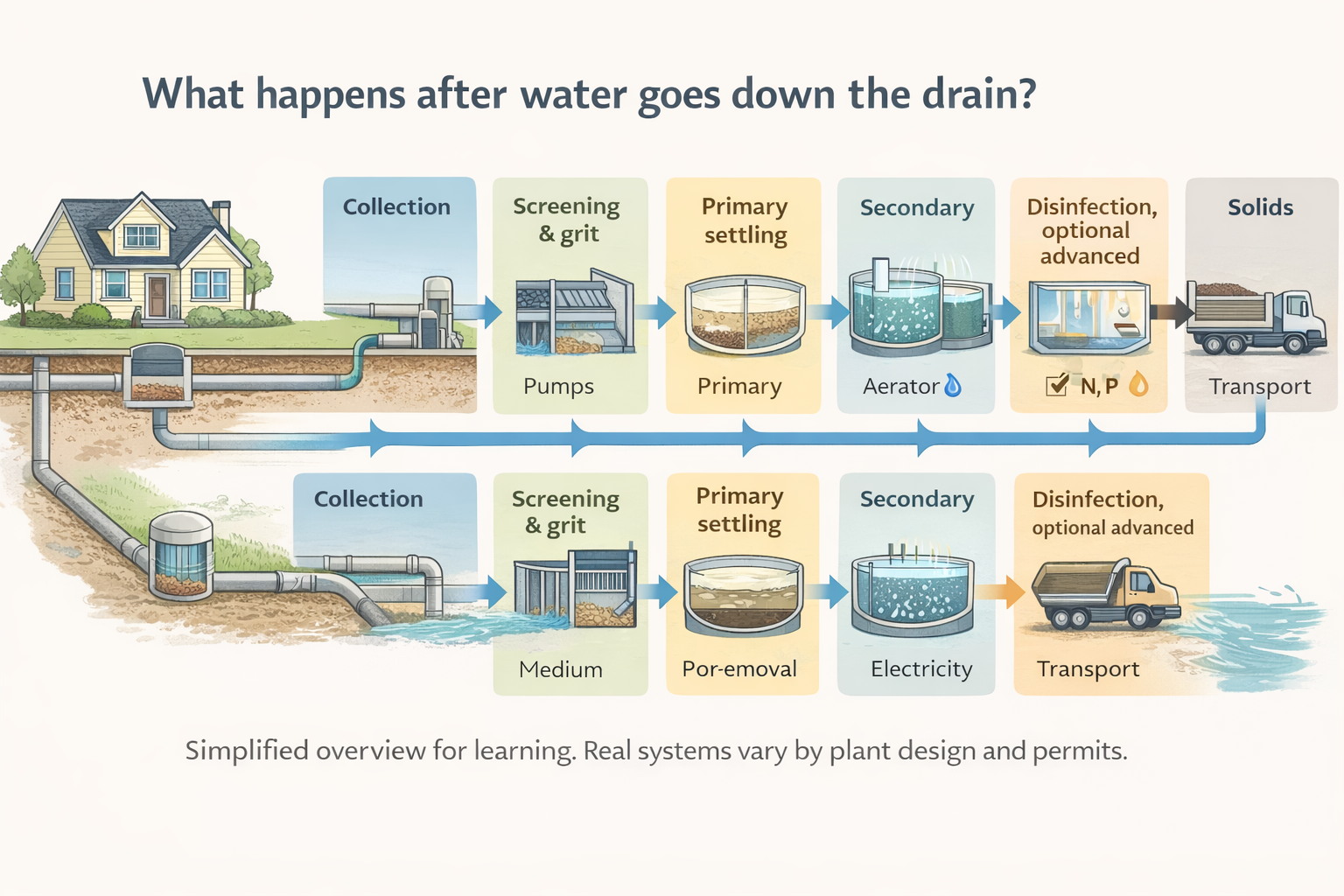
Diagram note: simplified overview. Local systems can add, combine, or rename steps based on permits and equipment.
Examples
A running toilet can raise sewer charges too
If sewer is based on indoor water use, a running toilet increases both the water volume and the sewer volume in the utility’s estimate. The billing method assumes indoor water goes into the sewer.
Outdoor watering may be treated differently, or not
Some utilities use a seasonal average, an irrigation meter, or another method to avoid charging sewer on most outdoor watering. Others do not. If sewer rises with outdoor watering, the cause is usually billing rules, not a sudden change at the plant.
Sewer can look higher than water
Wastewater service includes collection, treatment, disinfection in many systems, and solids handling under permit requirements. That can make the sewer portion look high even when water use is modest.
Back to the Water Bill Explained hub
Water Bill Explained (Plain English Guide)
Sources
U.S. Environmental Protection Agency, Primer for Municipal Wastewater Treatment Systems (PDF)
https://www.epa.gov/sites/default/files/2015-09/documents/primer.pdf
U.S. Environmental Protection Agency, Wastewater Basics 101 (PDF)
https://www.epa.gov/sites/default/files/2015-06/documents/epa-mou_wastewater_basics_101.pdf
U.S. Geological Survey, Water Science School, A Visit to a Wastewater Treatment Plant
https://www.usgs.gov/water-science-school/science/visit-wastewater-treatment-plant
U.S. Geological Survey, Water Science School, Wastewater treatment (Water Use)
https://www.usgs.gov/water-science-school/science/wastewater-treatment-water-use
Why this costs money
High control
Fix indoor leaks and prevent silent waste. Running toilets matter. Small drips add up.
Medium control
Be careful with what goes down the drain. Grease and materials that do not break down can contribute to clogs and equipment problems. This does not always change your bill directly, but it reduces risk.
Low control
Rates and billing rules are set locally. If you want to know whether sewer is estimated from water use, look for a note on your bill or language like sewer is based on water consumption.